A year ago, at Christmas, within our professional group we expressed a very specific wish for this 2025 that we have now left behind: that the Andorran citizen truly becomes empowered, makes their voice heard, and conveys their vision to those who govern.
We called for that collective “click” that makes us understand that each of our opinions has value and that, if we do not assert it, others will decide for us. Curiously, a few days later, our Head of Government, in his New Year’s address on 31 December 2024, announced the intention to promote an innovative strategy to listen to citizens and help build a shared vision of Andorra’s future.
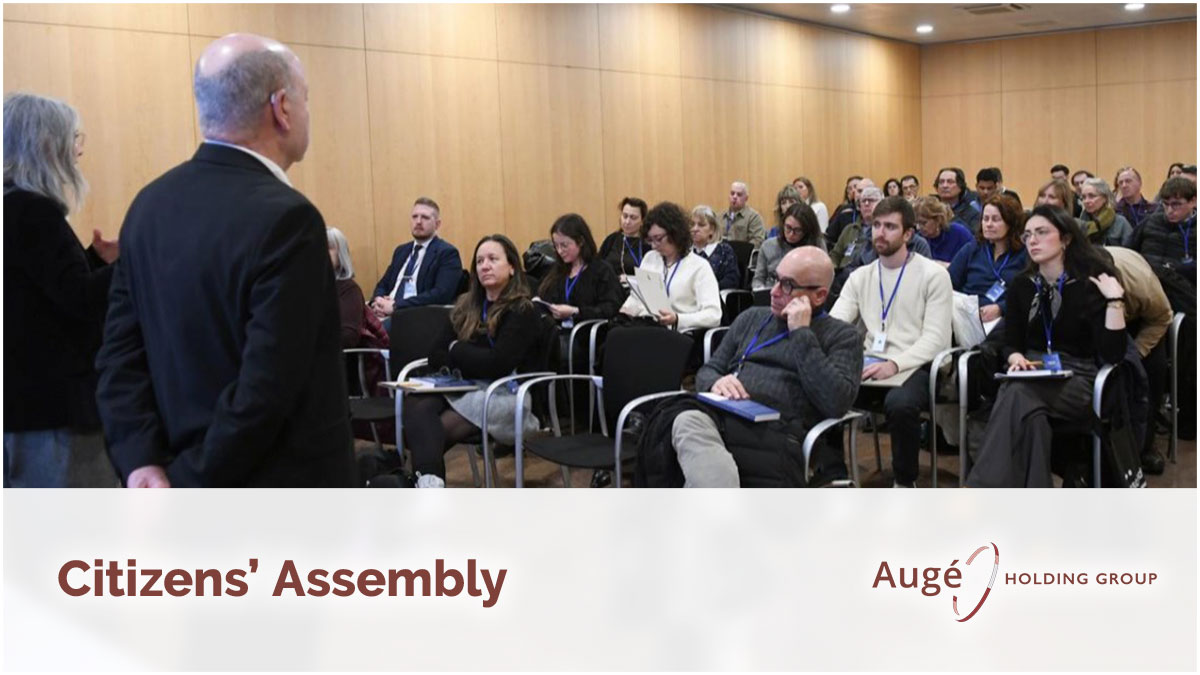
Well then, for once it seems that “destiny” has allowed wish and commitment to materialize in the participatory process “We trace Andorra’s future in a changing world” and in the creation of a Citizens’ Assembly made up of 50 people, selected from 457 applications, with representativeness criteria by nationality, age, sex, parish, employment situation, and level of education.
Table of contents
ToggleOn paper: an inspiring approach
A representative assembly of society, deliberating over several days on the country’s major challenges and working on more than a hundred proposals collected in an initial phase, structured into five broad areas:
- Health and well-being,
- Energy transition and the environment,
- Demography and housing,
- Economic diversification and digital transition, and
- Culture, identity, and education.
It sounds like deliberative democracy, like engaged citizens, like that “new era” of real empowerment that many of us call for.
Recent history: the risk that everything ends up in a drawer
But if our recent history should have taught us anything, it is that good intentions are not enough. This is not the first time Andorra has organized collective exercises to reflect on the future.
Let us recall the project Andorra has a future (2010–2012), and the Brand Andorra project (2016–2019), promoted by the CEA, with studies, workshops, and high-quality documents that were meant to help reposition the country’s image and strategy. Both processes ended up, to a large extent, in the drawer of history.
And now, in fact, reading some reports about the Citizens’ Assembly, I detect this risk once again. It is said that the 50 citizens will work on the proposals collected since October, that they will produce a strategic report that will be made public and forwarded to the Government, the General Council, and the Comuns. But at the same time, we are reminded that these conclusions will not be binding and that, in fact, there is no formal guarantee that they will be studied in committee or incorporated into the legislative or governmental agenda, as has already happened with reports from Andorra Research and Innovation or the Chamber of Commerce.
And now, in fact, reading some reports about the Citizens’ Assembly, I detect this risk once again. It is said that the 50 citizens will work on the proposals collected since October, that they will produce a strategic report that will be made public and forwarded to the Government, the General Council, and the Comuns. But at the same time, we are reminded that these conclusions will not be binding and that, in fact, there is no formal guarantee that they will be studied in committee or incorporated into the legislative or governmental agenda, as has already happened with reports from Andorra Research and Innovation or the Chamber of Commerce.
Are we facing a bold reinterpretation of participatory democracy or a new exercise in institutional theatre to keep citizens entertained and, ultimately, controlled? Is this about sharing power or managing discontent? The problem is that trust is a scarce asset, and that leads us to ask whether they really want our opinion or only our photo.
Wanting to believe: first step and collective learning
This is only the first step. A young democracy like ours needs to experiment with new forms of participation, and one cannot move overnight from a purely representative system to one in which citizens’ assemblies have binding power. It takes time, learning, and mutual trust.
Three commitments
It will not be enough to produce a brilliant report and hold a press conference and take the photo, of course! If we want this Citizens’ Assembly not to end up like other initiatives that “sleep the sleep of the just,” we will need, at minimum, three concrete commitments:
That the document be debated in a public session in the General Council;
That a clear timetable be set for the Government and the Comuns to respond in writing to the main recommendations; and
That, after some time, there be accountability for what has been implemented, what has not, and why.
Only in this way will this innovative strategy to listen to citizens cease to be an aesthetic exercise and become a real tool of co-governance. Only then can we say that, truly, the country is building a long-term vision that goes beyond legislatures and party interests
The wish for 2025–2026: empowerment with consequences
–That a new era of real empowerment of the Andorran citizen begins– will only become reality if that citizen decides to take the step. If they participate, if they educate themselves, if they read, if they compare, if they organize, if they demand from their representatives that participatory processes have consequences. And if political leaders understand, once and for all, that listening is not only inviting people to speak, but being willing to change attitudes, priorities, and policies in light of what citizens express
I therefore reinforce the wish, thinking about the future of the country, imagining that this Citizens’ Assembly is not an isolated chapter, but the beginning of a new political culture. One where, in a few years, we can say: we knew how to seize that opportunity, we ensured that people’s voices had real impact, we integrated their proposals into a true strategic plan for the country. One where our welfare state, our economic model, our relationship with Europe, and our territorial management are the result of a mature dialogue between institutions and citizens.